Active Learning: A School Year in Six Words
Summing up a school year in 6 words is challenging yet engaging! My group and I examined an active learning assignment done by students at Coonley School. Students from first to seventh grade were asked to sum up their school year in a six word Memoir. The students were provided were the following prompts...
- Tell something you like about Coonley
- What activity did you really enjoy this school year?
- Write about yourself
- Give advice to others
The students then used Google slides to share their memoir. Some inserted pictures or drawing they thought tied well with their memoir. This is active learning because it engaged students in deep thinking rather than surface learning. It promotes higher order thinking skills. The students had to analyze their school year and create their memoir.

(Image Source: Padlet)
We started our Padlet our with a summary of the activity. Then we listed the active learning traits displayed in this assignment, Then we listed opportunities for Growth and suggestions, how to modify for students with different needs, and even gave an example of how this could be SPED friendly for students with special needs. Here is the link to our Padlet we created to analyze the activity a little more in depth. Padlet Group Assignment
Active Learning is Key to Mastery

(Image Source: Rockhurst High School Blog)
As a Middle school Math teacher, I always tell my students you have reached the level of mastery in Math when you can apply what you learned and teach it to others. This is why most of my classwork consists of Real-world based application. I approach the students with real world based problems and have them apply the mathematics they learned. I won't lie and say this was a piece of cake to do. It took time and 3 years of mastering my curriculum before I was able to implement this, and I am still constantly learning and adjusting. But I can speak honestly when I say that the learning outcome has spoken volumes. The level of rigor built from allowing students to work together and share their thoughts through active learning helped them all learn how to problem solve and persevere. Most kids give up when given a challenging math problem, but I have seen my students break the problems down and learn from one another. Active learning in my classroom has created mathematicians and problem solvers!
Below is in image I thought gave a well written definition of Active learning and provided great strategies!
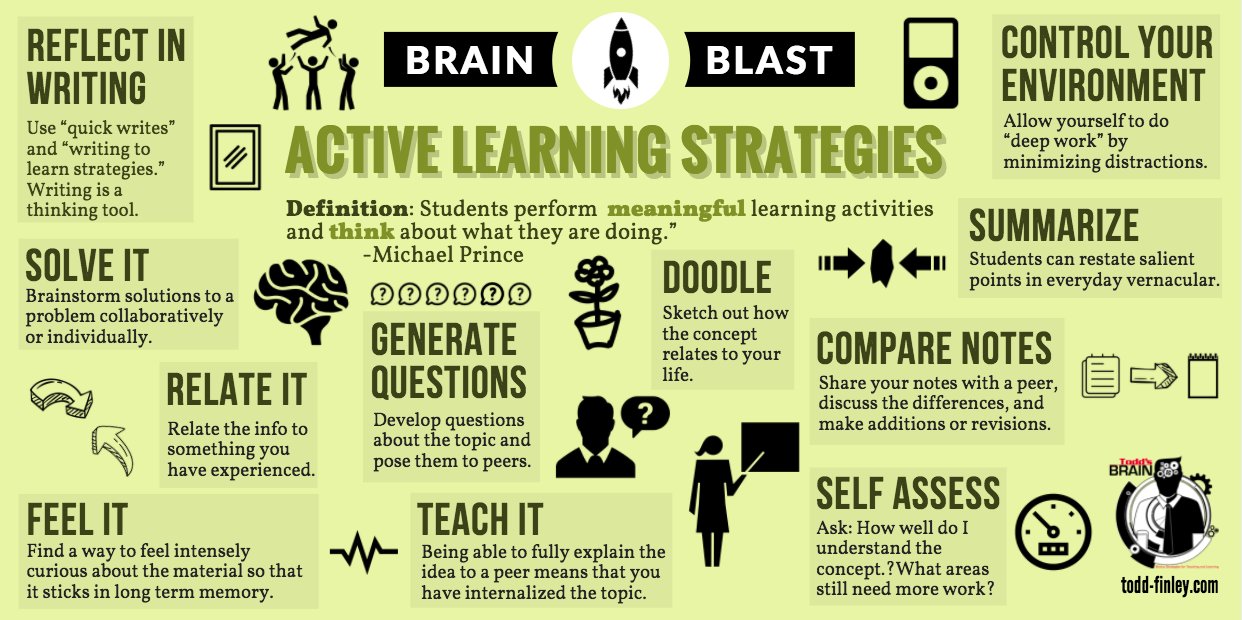
(Image Source: PBS Twitter)
There are many teaching strategies that lend themselves to active learning. One new one that many are talking about is the Flipped classroom. The model is exactly what it is titled. The students do the learning at home and come to school and apply the learning in the classroom through a group activity or project with their peers. I have tried this once or twice this year. It is a bit difficult when students do not all have internet access or have a hard time learning thing on their own. But this is something I want to start to implement more next year.

(Image Source: The University of Texas at Austin)
Here are two other resources that are beneficial for anyone who wants to learn about Active Learning and how to successfully implement it.
This comment has been removed by the author.
ReplyDeleteHi Amelia,
ReplyDeleteThank you for your very colorful and interesting blog entry. We are almost half way through the course and my awareness of teaching with technology is sinking in. I'm a dietitian that has spent over 20 years feeding children at a Chicago pediatric hospital. It has been very humbling. It has also been quite rewarding to start a child on a tube feeding and work with the family to achieve the goal of total oral feedings by the child. I have left that position and currently work with the Head Start programs of Chicago bases at Dominican University (DU). Our staff are preceptors for the dietetic interns learning the field of community dietetics. I provide this overview because the traditional way of teaching and being a preceptor has changed. I like what you discussed and graphically display about teaching strategies. This is a more updated way to teach. The information about the "Flipped classroom" is also something that can be incorporated into our program. Although our program is a supervised practiced, there is some work that the interns can accomplish on their own or at home. After reviewing work, the interns can analyze, apply and create new projects for presentations to our staff. We are always looking for fresh new ideas to educate the preschool children and their parents.
Love the active learning infographic!
ReplyDelete